
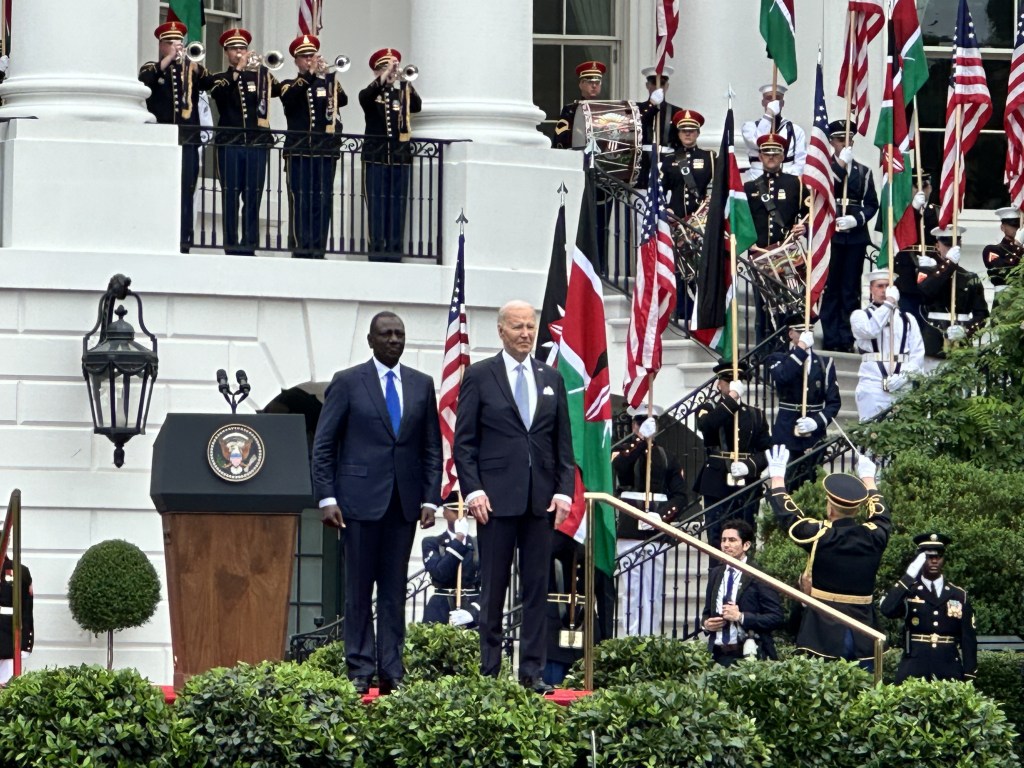
In the wake of President William Ruto’s state visit to the United States from May 22nd to 23rd, 2024, a Pan-African lens offers a critical perspective on Kenya’s deepening ties with Washington. This visit, marking 60 years of U.S.-Kenya relations, prompts a reevaluation of the role Kenya plays in the global arena, particularly as a partner to the U.S. in a region surrounded the ‘ring of fire’ that are conflicts going on in the East African region. These conflicts include right within the East African Community’s Congo DRC, and new addition Somalia’s dispute with her northern region with separatist ambitions, Somaliland, the sea access dispute between Ethiopia and Eritrea and of course The Sudan.
The Proxy Question Revisited
President Ruto’s visit to the U.S. was a historic occasion, celebrated with state dinners and high-level discussions. However, beneath the veneer of diplomatic cordiality, there are pressing questions about the true nature of this partnership. Is Kenya serving as a proxy for U.S. interests, and if so, at what cost?
Historical Context of Betrayal
The U.S. has a checkered history of alliances that often leave countries worse off—be it the protracted turmoil in Iraq, the chaos following the withdrawal from Afghanistan, or the shattered state of Libya post-intervention. The Sahel region’s instability, the unending strife in Palestine, and the scars left in Vietnam and Cambodia are testaments to the aftermath of U.S. involvement.
Ruto’s Visit: A Symbol or a Shift?
During his visit, President Ruto engaged in talks that spanned democracy, governance, human rights, and security cooperation. Discussions about the issues above shouldn’t be dismissed. The reality however is that they must be weighed against the backdrop of past U.S. actions – Can the U.S. be trusted? U.S. actions have undermined sovereignty and self-determination in various nations at best; at worst, arguably the U.S. has left a trail of carnage across the world when you consider U.S. caused crises including Vietnam, Cambodia, Nicaragua, Afghanistan, Iraq, Libya, Syria, not to mention countries whose economies have been left in tatters due to U.S. Sanctions including Eritrea, Zimbabwe, Venezuela, Cuba, Iran, N. Korea and others.
A Call for Vigilance
As Kenya steps into a more prominent role on the international stage, it is essential to remain vigilant. A Pan-African approach must prevail and prioritize the importance of autonomy and regional solutions. It serves as a cautionary reminder that partnerships with superpowers should not come at the expense of a nation’s agency or regional stability.
Conclusion
President Ruto’s state visit was an inflection point in Kenya-U.S. relations, but it also must serve as a moment for reflection. From a Pan-African perspective, it is a call to ensure that Kenya’s future is not compromised by external influences and that its leadership remains true to the aspirations of its people and the broader African community. It’s unclear how exactly Kenya whose trade with the U.S. is minimal stands to gain from seeking partnership with such a geographically distant neighbor. Ideologically, The United States approach to partnership is predatory to say the least. It’s difficult too see what there is to gain for Kenya whose economy would be far better enhanced by a full embrace of the African Continental Free Trade Agreement and greater trade ties within the East African Community and region, to include Somalia and the rest of the horn of Africa.


 The Brief Scoop
Leave a comment